
If you have a large maple tree with dense shade and shallow roots that make it impossible to grow grass underneath, there’s a good chance you’re looking at a Norway maple. For decades, this European import was planted throughout Montgomery County and across Maryland as a street tree and yard ornament. It seemed perfect at the time: fast-growing, adaptable, and tolerant of urban conditions.
The problem? Norway maple is now recognized as an invasive species that crowds out native trees, reduces biodiversity, and creates ongoing maintenance headaches for homeowners. At Rock Creek Tree, Turf & Landscape, we’ve been removing Norway maples across Montgomery County since 2005, and we’ve seen firsthand the damage these trees cause to both landscapes and local ecosystems.
If you have a Norway maple on your property, here’s what you need to know about why removal is often the best long-term solution.
What is a Norway Maple?
Norway maple (Acer platanoides) is a deciduous tree native to Europe and western Asia. It was introduced to North America in the mid-1700s as a shade tree and became extremely popular in the 1950s and 1960s as a replacement for American elms lost to Dutch elm disease.
The tree grows 40 to 60 feet tall (sometimes taller) with a dense, rounded crown. It adapts to almost any growing condition, handles urban pollution, and tolerates poor soil. These traits made it a favorite for street plantings and residential yards.
Popular cultivars include Crimson King (with dark purple leaves) and Drummondii (variegated leaves), but all Norway maple cultivars that produce viable seeds contribute to the invasive problem.
How to Identify Norway Maple
Many homeowners don’t realize they have a Norway maple because it looks similar to native maples. Here’s how to tell them apart.
The Milky Sap Test
The easiest way to identify a Norway maple is to break off a leaf stem. Norway maples exude a thick, milky white sap from the broken petiole, while native maples like sugar maple and red maple have clear sap.
This test works reliably from spring through early fall. In late fall, trees pull sap out of their leaves before dropping them, so the test may not work then.
Leaf Characteristics
Norway maple leaves are opposite with 5 lobes that are coarsely toothed and sharply pointed. The leaves are generally wider than they are tall, unlike sugar maple leaves which are generally taller than wide.
Norway maples typically have 5 to 7 lobes (commonly 7), while sugar maples typically have 5, and red maples often look like they have only 3 main lobes.
Norway maple leaves are often larger than native maple leaves, sometimes reaching 10 inches in width.
Fall Color
Norway maple leaves turn yellow in the fall, while sugar maples turn orange or red. This yellow fall color is one of the distinguishing features, though it varies somewhat by cultivar.
Seeds (Samaras)
Norway maple fruit is a double samara set at an obtuse angle (greater than 90 degrees), while all native maples have samaras set at angles less than 90 degrees. The wide angle gives Norway maple samaras a distinctive coat hanger shape.
Bark
Norway maple bark is grayish-black with shallow, regular furrows. Young trees have smooth bark. The bark pattern is more regularly grooved than the shaggier bark typical of mature sugar maples.
Timing
Norway maples tend to leaf out earlier in the spring than other maples. If your maple is one of the first trees to green up in your neighborhood, it might be a Norway maple.
Why Norway Maple is a Problem
Norway maple is classified as an invasive species in Maryland and 17 other states. Here’s why it’s such a serious concern.
Crowds Out Native Trees
Norway maple is very shade tolerant and will thrive along forest edges or in the understory. This poses a problem for native understory plants that cannot compete with the relatively fast-growing Norway maple.
Norway maple outcompetes many trees, including the ecologically and economically important sugar maple. Studies have shown significantly less species diversity underneath Norway maples when compared to areas underneath native maples.
Unlike many invasive species that only colonize disturbed sites, Norway maple is one of the few introduced species that can successfully invade and colonize a virgin forest.
Reduces Biodiversity
The dense canopy of Norway maples can inhibit understory growth. This is likely attributed to drier, shadier conditions under Norway maples, but some studies have also suggested Norway maples release allelopathic chemicals into the soil that inhibit the growth of other plants.
Due to the dense canopy of Norway maples, forest diversity is starting to decline because the excess shade they create inhibits the regeneration of sugar maples and other native seedlings.
Native trees support far more native insects than Norway maples do. These insects, in turn, feed native bird populations. When Norway maples replace native trees, the entire food web suffers.
Aggressive Root System
The roots of Norway maples grow very close to the ground surface, starving other plants of moisture. Lawn grass and even weeds will usually not grow well beneath a Norway maple.
The shallow root system makes growing difficult for other native shrubs and wildflowers in the understory. In urban environments, the root systems also destroy pavement, requiring expensive repairs.
The shallow roots also create tripping hazards, lift sidewalks and driveways, and compete aggressively with other plants for water and nutrients.
Produces Thousands of Seeds
Norway maples are prolific seed producers. Each tree drops thousands of winged seeds annually, and research has shown that the normal maximum range of Norway maple seed travel is 165 feet from the parent tree.
Those seeds germinate readily and grow quickly. If you have a Norway maple on your property, you’re likely dealing with constant seedling removal throughout your yard and garden beds.
Weak Wood and Storm Damage
Norway maples often cause significant damage and cleanup costs for municipalities and homeowners when branches break off in storms as they do not have strong wood.
The trees also have a tendency for roots to wrap around themselves (girdling), which can kill the tree or make it structurally unstable.
Limited Wildlife Value
While native maples support hundreds of species of butterflies, moths, and other beneficial insects, Norway maples provide minimal ecological value. A study by Cincotta et al. (2009) found that foliar insect and fungal damage was significantly higher on native sugar maples than on the invasive Norway maples.
This might sound like a benefit, but it actually indicates that native insects haven’t evolved to feed on Norway maple. Fewer insects mean less food for birds and other wildlife that depend on them.
The Maintenance Headaches
Beyond the ecological problems, Norway maples create ongoing maintenance issues for homeowners.
Nothing Grows Underneath
The combination of dense shade and shallow roots makes it nearly impossible to establish grass, flowers, or ground cover beneath Norway maples. Most homeowners end up with bare dirt or sparse, struggling turf that kicks up dust when mowed.
Constant Cleanup
Norway maples drop debris year-round. Seeds (samaras) blanket the yard in late spring and early summer. Leaves and small branches fall throughout the growing season. Seedlings sprout everywhere and require constant removal.
Clogged Gutters
The prolific seed production and dense canopy mean gutters fill quickly with samaras and leaf debris, leading to drainage problems and potential roof damage.
Root Damage
The shallow, aggressive root system can damage driveways, sidewalks, patios, and even foundation walls over time. Repair costs can be significant.
Better Native Alternatives
If you remove a Norway maple, what should you plant instead? Montgomery County has many excellent native maples and other shade trees that provide all the benefits without the problems.
Red Maple (Acer rubrum)
Red maple is Montgomery County’s official tree. It’s adaptable, fast-growing, and provides brilliant fall color. Unlike Norway maple, red maple supports native wildlife and doesn’t create the same maintenance headaches.
Sugar Maple (Acer saccharum)
Sugar maple is the classic shade tree known for spectacular fall color and maple syrup production. It’s slower-growing than Norway maple but longer-lived and more valuable for wildlife.
White Oak (Quercus alba)
Maryland’s state tree, white oak is a long-lived native that supports more wildlife species than almost any other tree. It’s slower-growing but incredibly valuable for the ecosystem.
Tulip Poplar (Liriodendron tulipifera)
This fast-growing native reaches impressive heights and produces beautiful tulip-shaped flowers in spring. It’s an excellent choice for homeowners who want quick shade.
American Beech (Fagus grandifolia)
Beech trees create beautiful, smooth-barked specimens that provide year-round interest. They support native wildlife and tolerate shade well.
Red Oak (Quercus rubra)
Red oak grows faster than white oak while still providing excellent wildlife value. It adapts to various soil conditions and produces stunning fall color.
All of these native alternatives support local ecosystems, require less maintenance, and won’t spread invasively into natural areas.
Should You Remove Your Norway Maple?
The decision to remove a mature tree isn’t always easy, even when it’s an invasive species. Here are factors to consider:
Remove if:
- The tree is dropping seeds that germinate throughout your property or neighborhood
- You’re dealing with constant maintenance issues (bare ground beneath the tree, clogged gutters, root damage)
- Native vegetation nearby is being crowded out
- The tree is close to natural areas where seedlings could invade
- You want to improve biodiversity and wildlife habitat on your property
- The tree has structural problems or weak branch attachments
Consider keeping (temporarily) if:
- The tree is healthy and provides critical shade for your home’s energy efficiency, and you’re willing to manage seedling removal
- You plan to replace it soon but need time to establish a new shade tree first
- The tree is not actively spreading (though this is rare with mature Norway maples)
Even if you decide to keep the tree for now, commit to removing seedlings promptly to prevent spread, and plan for eventual replacement with a native species.
How Norway Maple Removal Works
Removing a mature Norway maple requires professional expertise, especially if the tree is large or near structures.
Assessment
We start by evaluating the tree’s size, location, and proximity to structures, power lines, and other obstacles. This determines the removal method and equipment needed.
Removal Methods
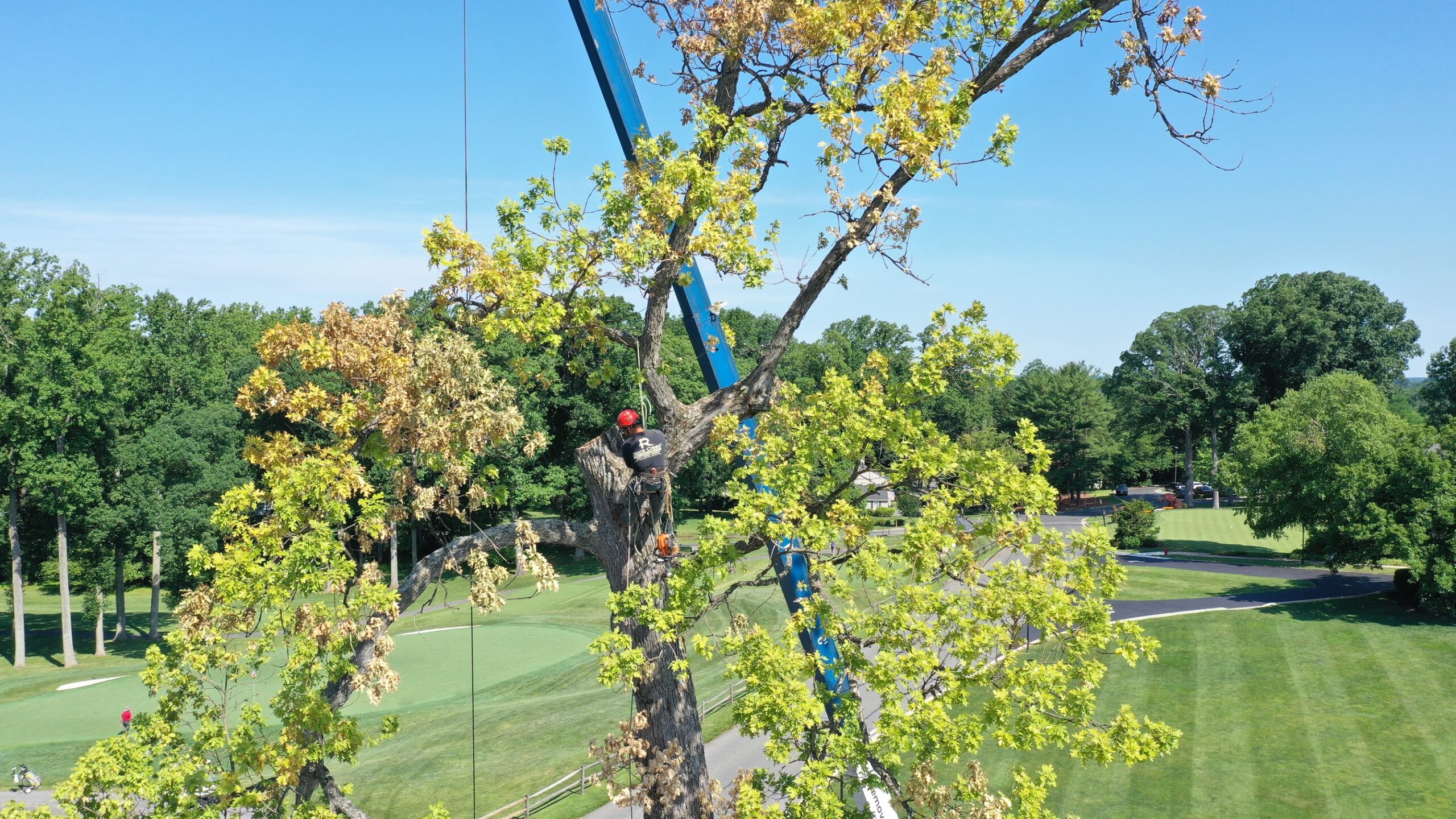
For trees in open areas, we may be able to fell the tree in sections. For trees near houses, power lines, or in tight spaces, we use specialized rigging or crane services to lift sections safely away from structures.
Norway maples can grow to over 100 feet tall, and mature specimens can be extremely large, requiring careful planning and professional equipment.
Stump Grinding
After the tree is removed, we recommend stump grinding to eliminate the stump below ground level. This prevents sprouting and allows you to replant or restore the area.
Norway maple stumps can resprout if left untreated, so complete removal or grinding is important.
Complete Cleanup
We remove all debris, branches, and wood from your property, leaving the area clean and ready for replanting or other landscaping.
Managing Norway Maple Seedlings
If you’re not ready to remove your mature Norway maple yet, at minimum you should control seedling spread.
Seedlings are easily hand-pulled from moist soil; larger saplings can be dug or pulled using equipment.
Check your property regularly (every few weeks during growing season) and pull or dig Norway maple seedlings before they get established. This prevents them from spreading into natural areas and reduces future removal costs.
The Cost of Removal
Norway maple removal costs vary based on tree size, location, and complexity. A medium-sized tree (30 to 60 feet) typically costs $700 to $900 for removal, while larger specimens can cost significantly more.
However, when you factor in the ongoing maintenance costs of dealing with a Norway maple (gutter cleaning, seedling removal, root damage repairs, and decreased property value from poor landscaping), professional removal often proves cost-effective in the long run.
Why Work with Rock Creek Tree
We’ve been removing Norway maples and other problematic trees across Montgomery County since 2005. Our crew understands the challenges these trees present and knows how to remove them safely, even in difficult locations.
We’re fully licensed and insured, and we follow strict safety protocols on every job. We also understand local ecosystems and can recommend native alternatives that will thrive on your property.
If you’re dealing with a Norway maple and you’re ready to make a change, we’re here to help.
Call Rock Creek Tree at 301-580-6023 or Contact Us for a free assessment and quote.
