
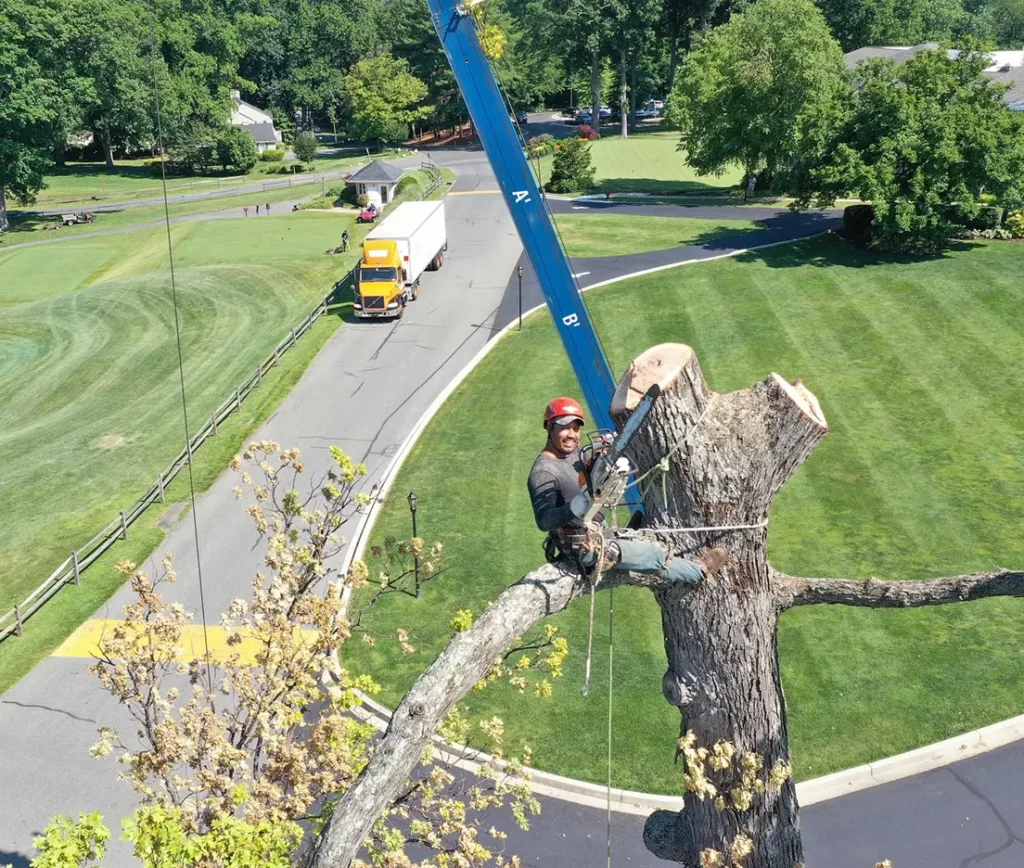
Your tree doesn’t have to look dead to be dying. A lot of tree diseases work from the inside out, and by the time you notice the problem, the damage is already done. Some diseases kill fast. Others take years to weaken a tree to the point where it becomes dangerous. Either way, catching them early gives you the best chance of saving the tree or at least removing it safely before it falls on its own.
At Rock Creek Tree, Turf & Landscape in Montgomery County, we see the same tree diseases every year. Some are manageable if you catch them in time. Others are death sentences for certain species. Knowing what to look for can help you spot problems before they turn into emergencies.
Emerald Ash Borer: The Ash Tree Killer
If you have an ash tree on your property, you need to know about Emerald Ash Borer (EAB). This invasive beetle has killed millions of ash trees across the eastern United States, and it’s well-established in Maryland. It was first detected in Prince George’s County in 2003 and has spread throughout the state, including Montgomery County and the Eastern Shore.
EAB is a small, metallic green beetle about half an inch long. The adults aren’t the problem. It’s the larvae that do the damage. They burrow into the tree’s cambium layer (the area just under the bark) and create serpentine tunnels as they feed. These tunnels cut off the flow of water and nutrients, essentially starving the tree to death. Even a large, healthy ash tree will die within three years of infestation.
How to Spot EAB
The tricky thing about EAB is that you usually don’t see it until the tree is already in trouble. Here’s what to look for:
Thinning canopy. The upper third of the tree starts to thin out and die back. This is often the first visible sign of infestation.
Sprouting below the canopy. When the top of the tree starts dying, the tree tries to compensate by pushing out new shoots and branches lower on the trunk. If you see a lot of new growth coming from the trunk or main branches, that’s a bad sign.
D-shaped exit holes. Adult beetles chew their way out of the tree, leaving behind small holes shaped like the letter D. These holes are about 1/8 inch across and are a clear indicator that EAB is present.
Woodpecker damage. Woodpeckers love EAB larvae. If you see a lot of woodpecker activity on an ash tree, especially if the bark is getting stripped away in patches (we call this “blonding”), there’s a good chance the tree is infested.
Serpentine galleries under the bark. If you peel back a piece of loose bark, you might see the S-shaped tunnels the larvae carved. This confirms EAB.
Vertical bark splits. As the tree weakens, the bark may start splitting vertically.
Can You Save an Ash Tree?
If the tree isn’t heavily infested yet, treatment is possible. Insecticide treatments (usually injections of emamectin benzoate or imidacloprid) can protect ash trees from EAB, but they have to be done regularly and they’re not cheap. Treatment makes sense for high-value trees in good locations, but for most residential ash trees, removal and replacement with a different species is the more practical option.
If you decide to treat, timing matters. Treatments should be done after the tree finishes flowering to avoid harming pollinators. Don’t wait until the tree is already dying. Once more than 50% of the canopy is gone, treatment usually won’t work.
Anthracnose: The Spring Fungal Disease
Anthracnose is a group of fungal diseases that show up in the spring, especially during cool, wet weather. It affects a lot of common trees in Maryland including oaks, maples, sycamores, dogwoods, and ash.
How to Spot Anthracnose
Brown spots along leaf veins. The fungus creates lesions that usually follow the veins of the leaf. In severe cases, these spots merge and kill the entire leaf.
Distorted young leaves. New leaves that are infected while still developing may grow twisted or curled because healthy tissue keeps growing around the dead areas.
Early defoliation. In bad years, the tree can lose most of its leaves by early summer. The good news is that many trees, especially sycamores, will push out a second flush of leaves later in the season.
Twig dieback. The infection can travel from the leaf down the petiole (leaf stem) and into the small twigs at the branch tips. This kills the tips and the fungus overwinters in the dead wood, reinfecting the tree the next spring.
Is Anthracnose Serious?
For most trees, anthracnose is more of a cosmetic issue than a death sentence. It looks bad, and repeated severe infections can weaken a tree over time, but it’s rare for anthracnose alone to kill a mature, otherwise healthy tree. The exception is dogwood anthracnose, which is more aggressive and can kill dogwoods if left untreated.
The best defense is good tree care. Rake up and dispose of fallen leaves in the fall to reduce the amount of fungus that overwinters around the tree. Prune out dead twigs and branches to remove infected wood. Improve air circulation by thinning dense canopies. In severe cases or for high-value trees, fungicide treatments can help, but they have to be applied preventatively in the spring before symptoms appear.
Bacterial Leaf Scorch: The Slow Decline
Bacterial leaf scorch is caused by a bacterium called Xylella fastidiosa. It’s common in Maryland and affects a variety of trees, but oaks, elms, and sycamores are the most susceptible.
How to Spot Bacterial Leaf Scorch
Browning leaf margins. The edges of the leaves turn brown and look scorched, like the tree isn’t getting enough water. This usually starts in mid to late summer.
Scattered symptoms throughout the canopy. Unlike drought stress, which tends to affect the whole tree evenly, bacterial leaf scorch shows up in scattered branches. You’ll see some branches with scorched leaves while others look fine.
Symptoms worsen over time. The first year, you might only notice a few affected branches. Each year, more of the canopy shows symptoms as the infection spreads.
Leaves stay attached. Unlike some diseases that cause early leaf drop, scorched leaves tend to hang on until fall.
Can You Treat It?
There’s no cure for bacterial leaf scorch. The bacterium lives in the tree’s xylem (the water-conducting tissue) and blocks water movement from the roots to the leaves. Some trees can live with the infection for years, slowly declining. Others go downhill faster, especially during dry summers when water stress is already an issue.
Antibiotic injections can suppress symptoms temporarily, but they’re expensive and have to be repeated every year. For most homeowners, the better option is to keep the tree as healthy as possible with proper watering and care, and plan for eventual removal when the decline becomes too severe.
Verticillium Wilt: The Root-Borne Killer
Verticillium wilt is caused by soil-borne fungi (Verticillium albo-atrum and Verticillium dahliae) that invade through the roots and spread through the tree’s vascular system. It’s common in Maryland and affects hundreds of tree species including maples, ashes, magnolias, and redbuds.
How to Spot Verticillium Wilt
One-sided symptoms. This is the classic sign. One side or section of the tree shows wilting, yellowing, or browning leaves while the rest of the tree looks healthy.
Leaf scorch and curling. Leaves dry out and curl at the edges.
Stunted growth. New growth is smaller and weaker than normal.
Vascular discoloration. If you cut into an affected branch, you’ll often see brown or black streaking in the wood. This is the clogged vascular tissue.
What to Do About It
There’s no cure for verticillium wilt. Once a tree is infected, the fungus is in the soil and in the tree’s system. Some trees can wall off the infection and survive for years. Others decline rapidly.
Remove dead and dying branches to reduce stress on the tree. Water during dry periods. Fertilize if needed. Basically, do everything you can to keep the tree healthy so it has a better chance of fighting off the infection. If the tree is too far gone, remove it and don’t replant the same species in that spot. The fungus can live in the soil for years.
Fire Blight: The Bacterial Disease of Fruit Trees
Fire blight is caused by the bacterium Erwinia amylovora and primarily affects trees in the rose family, including apples, pears, crabapples, hawthorns, and ornamental fruit trees. It’s common in Maryland and spreads easily during warm, wet spring weather.
How to Spot Fire Blight
Blackened, curled leaves. The leaves look like they’ve been scorched by fire, hence the name.
Shepherd’s crook. Infected branch tips curl over into a characteristic hook shape.
Cankers on branches. Sunken, discolored areas on the bark where the infection has girdled the branch.
Oozing. In wet conditions, infected areas may ooze a milky or amber-colored bacterial slime.
Treatment
Prune out infected branches as soon as you see them. Cut at least 8-12 inches below the visible infection into healthy wood, and disinfect your pruning tools between cuts with rubbing alcohol or a 10% bleach solution. Burn or bag the infected wood; don’t leave it lying around.
In severe cases or for high-value trees, antibiotic sprays (streptomycin or oxytetracycline) can be applied during bloom to prevent infection, but they have to be timed correctly and repeated applications are usually needed.
Powdery Mildew: The Cosmetic Fungus
Powdery mildew is easy to recognize. It looks like someone dusted the leaves with white powder. It’s caused by various fungal species and is common in Maryland, especially in shady areas with poor air circulation.
How to Spot Powdery Mildew
White, powdery coating on leaves. This is the fungal growth. It usually starts on the upper surface of the leaves but can spread to cover both sides.
Distorted leaves. Infected leaves may curl, twist, or grow abnormally.
Reduced growth. Heavily infected trees may have stunted growth.
Is It Serious?
Powdery mildew is mostly cosmetic. It looks bad, but it rarely kills trees. Repeated severe infections can weaken a tree over time, and the fungus can reduce photosynthesis by covering the leaves, but most trees tolerate it just fine.
Improve air circulation by pruning, avoid overhead watering, and clean up fallen leaves. Fungicide sprays can control it if needed, but for most situations, it’s not worth the effort.
Oak Wilt: Not Common in Maryland (Yet)
Oak wilt is a devastating fungal disease (Ceratocystis fagacearum) that kills oak trees, especially red oaks. It’s a major problem in the Midwest and parts of the mid-Atlantic, but so far it’s not widely established in Maryland. That said, it has been detected in a few counties, so it’s worth knowing what to look for.
How to Spot Oak Wilt
Rapid leaf discoloration. Leaves turn brown starting at the edges and tips, often with a distinct line between green and brown tissue.
Symptoms start at the top. The crown of the tree is affected first, and symptoms spread downward.
Rapid defoliation. Red oaks can die within a few weeks of showing symptoms. White oaks are more resistant and may take years to decline.
Clustered infections. Oak wilt spreads through root grafts between nearby trees, so you’ll often see multiple trees in a group declining together.
If you suspect oak wilt, contact the Maryland Department of Agriculture immediately. Early detection and containment are critical to preventing spread.
How to Catch Tree Diseases Early
The best way to spot tree diseases early is to pay attention to your trees. Walk your property a few times a year and look for changes. Spring, mid-summer, and fall are good times to check.
Look at the leaves. Discoloration, spots, wilting, early drop, or unusual growth patterns are all signs something’s wrong.
Check the bark. Cracks, holes, cankers, oozing sap, or missing bark can indicate disease or pest problems.
Watch for diebacks. Dead branches in the canopy, especially at the top of the tree, are often the first sign of a serious problem.
Notice changes in growth. Stunted growth, sparse foliage, or one-sided symptoms can indicate root or vascular diseases.
Pay attention to the whole tree. Is it leaning more than it used to? Are there mushrooms or fungus growing at the base? Is the soil around the roots lifting or cracking?
If you see something that doesn’t look right, call a professional. The earlier a problem is caught, the better your chances of saving the tree or at least removing it safely before it becomes a hazard.
Final Thoughts
Tree diseases are part of life in Maryland. Some you can treat, some you can manage, and some mean the tree has to come down. The key is catching problems early when you still have options.
At Rock Creek Tree, we help homeowners identify tree diseases, figure out whether treatment makes sense, and remove trees that are too far gone. If you’ve noticed something off about one of your trees, don’t wait. Call Rock Creek Tree, Turf & Landscape at 301-945-7677 or contact us for an evaluation. We’ll take a look, tell you what’s going on, and help you figure out the best next step.
