May 28, 2026
Power Lines and Trees: What You Need to Know
Trees near power lines are dangerous. Learn utility rules, safe distances, and when to call for help from the experts at Rock Creek Tree
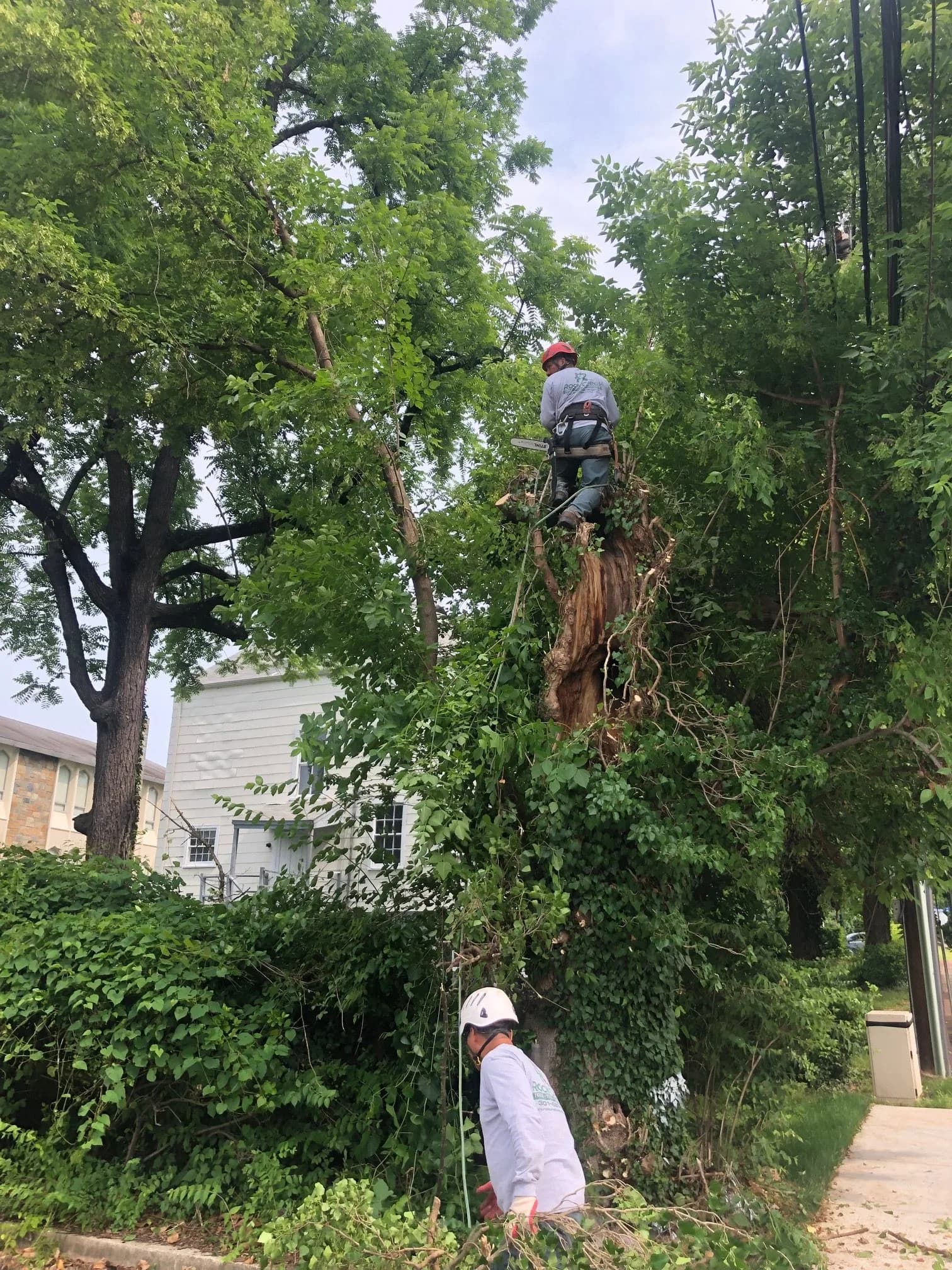
Trees and power lines don’t mix. A branch touching a live wire can start a fire, cause a power outage, or kill someone. It’s one of the most dangerous situations a homeowner can face, and it’s also one of the most common. Trees grow. Power lines don’t move. Eventually, something has to give.
At Rock Creek Tree, Turf & Landscape in Montgomery County, we deal with trees near power lines all the time. We know the rules, we know the risks, and we know when to call the utility company instead of touching the tree ourselves. Here’s what every homeowner needs to understand about trees and power lines.
The Danger Is Real
Electricity doesn’t care if a branch is alive or dead, wet or dry. If wood makes contact with a high-voltage line, the electricity can arc through the tree, the ground, and anything (or anyone) nearby. You don’t even have to touch the wire directly. Electricity can jump gaps through the air, especially in wet conditions.
People die every year from contact with power lines during tree work. Professionals die. Experienced climbers die. Homeowners with chainsaws definitely die. This isn’t something you gamble with.
If a tree or branch is touching a power line, or if it’s close enough that cutting it could cause it to fall into the line, do not touch it. Call the utility company. Call a licensed tree service that’s trained and equipped to work near power lines. Do not try to handle it yourself.
Who Owns the Tree? Who Owns the Line?
The first question people ask is, “Whose responsibility is this?” The answer depends on where the tree is and what kind of power line it’s near.
Utility Company Responsibility
The utility company (Pepco, BGE, or whoever provides power in your area) is responsible for maintaining clearance around their lines. That means they have the right to trim or remove trees that are growing into the lines, even if the tree is on your property.
Utility companies focus on transmission lines (the big high-voltage lines on tall poles or towers) and distribution lines (the medium-voltage lines that run along streets and into neighborhoods). They’ll send crews out periodically to prune trees back from these lines.
The trimming they do isn’t pretty. Utility crews are focused on clearance and safety, not aesthetics. They’ll cut whatever needs to be cut to keep the lines clear, and your tree might end up looking lopsided or butchered. That’s the trade-off for living near power lines.
Homeowner Responsibility
You’re responsible for keeping your trees away from the service drop —the line that runs from the utility pole to your house. This is the line that brings power to your meter and into your electrical panel.
If a tree on your property is growing into the service drop, it’s your job to deal with it. The utility company won’t trim it for you, and if the tree causes a problem (power outage, fire, damage to the line), you could be liable.
You’re also responsible for any trees on your property that might fall into power lines during a storm. If you have a dead or dying tree that’s close to a power line, you need to have it removed before it becomes a hazard.
Street Trees and Right-of-Way Trees
If the tree is in the public right-of-way (the strip of land between the street and your property line), it’s usually the responsibility of the local government or the utility company, depending on the tree’s location relative to the power lines.
In Montgomery County, trees in the right-of-way are protected under the Roadside Tree Law, and you need permits to remove them. If a right-of-way tree is growing into power lines, contact the utility company first. They’ll coordinate with the county to handle it.
Safe Distances: How Close Is Too Close?
There’s no universal rule for how far a tree needs to be from a power line. It depends on the voltage of the line, the type of tree, and how fast it grows. But here are some general guidelines:
Low-voltage lines (service drops to houses): Keep trees at least 10-15 feet away. This gives you clearance for the tree’s mature canopy and room to work safely if pruning is needed.
Medium-voltage distribution lines (along streets): Keep trees at least 20-25 feet away. Faster-growing trees (like tulip poplars, silver maples, or willows) need even more distance because they’ll grow into the lines quickly.
High-voltage transmission lines (the big ones): These require much larger clearances—often 50 feet or more on either side. You generally won’t be planting trees near these anyway, but if you have a large tree that’s grown close to a transmission line, the utility company will handle it.
When you’re planting new trees, think about the mature size of the tree and where the power lines are. A tree that’s 10 feet tall now might be 50 feet tall in 20 years. Plan accordingly.
What Happens When a Tree Grows Into Power Lines?
If you notice a tree growing into power lines, don’t wait for it to become a problem. Here’s what to do:
Call the Utility Company First
If the tree is touching or very close to a distribution line (the lines that run along the street), call the utility company. In Montgomery County, that’s usually Pepco (1-877-737-2662) or BGE, depending on your location.
The utility company will send someone out to assess the situation. If the tree is interfering with their lines, they’ll either trim it themselves or coordinate with a contractor to do it. This service is usually free because it’s part of their responsibility to maintain clearance.
Hire a Licensed Professional for Service Drops
If the tree is near the service drop (the line running to your house), the utility company won’t touch it. You need to hire a licensed tree service that’s trained to work near power lines.
Not every tree service is qualified to work near energized lines. The crew needs specialized training, equipment, and insurance. At Rock Creek Tree, we’re trained and equipped to handle trees near power lines safely. We know how to assess the risk, make the right cuts, and avoid contact with the lines.
Never attempt this yourself. Even if the line looks small or “just a phone line,” assume it’s energized. People have been killed by lines they thought were dead.
If a Branch Is Touching the Line
If a branch is already touching a power line, do not touch the tree or the branch. Do not try to move it. Do not climb the tree. Do not use a pole saw or a chainsaw anywhere near it.
Call the utility company immediately. Explain that a tree or branch is in contact with a power line, and they’ll dispatch a crew to de-energize the line or remove the hazard safely.
Storm Damage: Trees on Power Lines
After a big storm, trees and branches come down on power lines all over Montgomery County. If this happens on your property, here’s what you need to know:
Don’t approach the tree or the line. A downed power line can still be energized, even if the power is out in your neighborhood. The line could be lying on the ground, tangled in branches, or hidden under debris. Assume it’s live.
Call 911 and the utility company. Report the downed line immediately. The utility company will send a crew to de-energize the line and make the area safe.
Keep people and pets away. Set up a safe perimeter and make sure no one goes near the tree or the line. Electricity can travel through the ground, so even standing near a downed line can be dangerous.
Wait for professionals. Once the line is de-energized and the utility company clears the scene, you can hire a tree service to remove the tree. Don’t try to cut it yourself, even after the power is off. The tree may be under tension from the weight of the lines, and cutting it could cause it to shift or spring back unpredictably.
Trimming Near Power Lines: Why You Shouldn’t DIY
A lot of homeowners think they can trim a few branches near a power line with a pole saw or a ladder. This is a bad idea for several reasons:
You can’t tell if a line is energized just by looking at it. Even if the line looks like a phone or cable line, it could be a service drop carrying 120-240 volts. That’s enough to kill you.
Tools conduct electricity. Metal pole saws, aluminum ladders, wet wood—all of these can conduct electricity if they contact a live line.
Trees conduct electricity. If your saw touches a live wire, the electricity can travel down the blade, through the tree, and into you.
Branches can fall unpredictably. When you cut a branch near a power line, it can twist, swing, or fall into the line even if you planned for it to fall the other way. Once it makes contact, you’re in a dangerous situation.
Professional tree services use insulated tools, bucket trucks to maintain safe distances, and techniques to control where branches fall. Even then, we sometimes call the utility company to de-energize the line before we work.
Planting Trees Near Power Lines
If you’re planting new trees, think about where the power lines are and choose the right tree for the location.
Under or near power lines: Plant small trees that won’t grow taller than 15-20 feet. Good options include dogwoods, redbuds, serviceberry, and ornamental cherries.
Away from power lines: You can plant larger trees like oaks, maples, or tulip poplars, but make sure they’re far enough away that the mature canopy won’t reach the lines.
Check with the utility company before planting if you’re unsure about clearances. Some utility companies have guidelines or even free tree programs that provide appropriate species for planting near lines.
What About “Dead” Lines?
People sometimes assume that the lower lines on a utility pole are phone or cable lines and not energized. This is dangerous thinking.
All lines should be treated as live. Unless the utility company has confirmed that a line is de-energized, assume it’s hot. Phone and cable lines can be energized if they’ve been damaged or if they’re in contact with a power line above them.
If you’re not sure what a line is, don’t touch it. Call the utility company and ask.
Liability: Who Pays If Something Goes Wrong?
If a tree on your property falls and takes down a power line, you’re generally not liable for the utility company’s repair costs—unless negligence is involved.
Negligence means you knew the tree was dangerous and didn’t do anything about it. If you had a dead or leaning tree that you ignored, and it fell and damaged the power line, the utility company could come after you for the cost of repairs.
Regular tree inspections help protect you here. If you’re maintaining your trees and addressing hazards as they come up, you’re doing your due diligence.
If your tree damages someone else’s property (your neighbor’s house, their car, their fence) when it falls into a power line, your homeowner’s insurance may cover it, but again, negligence can affect coverage.
Final Thoughts
Trees and power lines are a bad combination, and the risks are serious. Don’t guess. Don’t assume a line is safe. And definitely don’t try to trim or remove a tree near a power line yourself.
If you have a tree growing into a power line, call the utility company if it’s a distribution line, or call a licensed professional if it’s a service drop. If a tree is down on a line, call 911 and stay away.At Rock Creek Tree, we’re trained to work safely near power lines, and we know when to call in the utility company instead of handling it ourselves. If you’ve got a tree near a power line and you’re not sure what to do, call Rock Creek Tree, Turf & Landscape at 301-580-6023 or contact us . We’ll assess the situation, coordinate with the utility company if needed, and make sure the job gets done safely.